Business News Clips

Forex

Saturday, November 23, 2013

Maria Bartiromo Leaving CNBC

Business Insider has an “exclusive” report with the headline “Here’s Why Maria Bartiromo Is Leaving CNBC For FOX Business” that is currently burning up the site’s homepage with a publicly-displayed 81,417 views (as of 8pm ET). But the real title should be “Here’s Why Maria Bartiromo Wants You To Believe She’s Leaving CNBC for FOX Business.”
The piece, which features a co-byline of finance reporter Julia La Roche and editor-in-chief Henry Blodget, reads like the definitive inside scoop on why Bartiromo decided to make her big move, but according to a senior tv news executive who spoke to Mediaite, it doesn’t tell the whole story.
Business Insider cites a “source familiar with Bartiromo’s thinking,” who we are going to have to assume is not Bartiromo or her publicist, as listing three reasons for her departure from CNBC: “Money,” “visibility,” and “the opportunity to, once again, help build something.”
As for money, the piece says Fox made a “big offer” and while CNBC “increased its own offer” they wouldn’t quite match Fox. This implies some sort of bidding war for Bartiromo, when our source tells us that CNBC was simply not willing to pay the anchor anywhere near what Fox was willing to pay and generally was not that concerned about letting her go.
In terms of visibility, Business Insider notes that Fox Business consistently trails CNBC in ratings, which makes the move seem a bit more like a step in the wrong direction for Bartiromo (albeit a potential coup for Fox). As for the promised Sunday program on Fox News proper, we will have to wait until her contract is finalized to see how that pans out.
Finally, the “opportunity to build something” seems like a bit of a stretch when describing the move from one business cable news channel to another. Its not like Fox Business just launched. Nor is it remotely on the level of say Nate Silver’s move from writing a blog on The New York Times to launching a full-scale website for ESPN or Katie Couric’s potentially game-changing move from ABC to Yahoo.
Business Insider’s report is littered with hopeful spins on Bartiromo’s situation along with overly gushing assessments of her career. She’s “affectionately known as the ‘Money Honey.’” She’s one of CNBC’s “earliest and biggest stars.” And, CNBC may “have to make some changes in the wake of Bartiromo’s departure.”
On that issue, our source tells us that CNBC is not going to have to make any changes at all. While Business Insider claims that the network may have trouble booking big guests without Bartiromo, we are told CNBC is “not at all” concerned about their booking abilities in a post Bartiromo world. To their credit, La Roche and Blodget do quote another CNBC insider as saying, “I have a feeling her prowess was always a little overrated in that department.”
The kicker comes in an anonymously-sourced quote about Bartiromo’s future at Fox Business from someone “who has worked with her” that reads like a parody of flattery:
“She is a bulldog. She just works really, really hard. She’s an impressive person. She’s just driven. She’s smart. She’s energetic…She fiercely guards her territory…She’s tough in a good way… She’s just a hard working, driven person and she’s competitive. I think that’s going to be interesting to see what they’re able to do with that.”
Wow. All of those things may be true about Bartiromo, but ultimately the quote takes an already excessively laudatory piece, positioned as a reporting exclusive, and ensures its place in the spinners hall of shame.

Thursday, September 13, 2012

Dow Closes at Highest Level Since 2007 on Fed Stimulus News

NEW YORK -- The stock market staged a huge rally after investors got the aggressive economic help they wanted from the Federal Reserve. The Dow Jones industrial average is finishing up more than 200 points.

The gain pushed the Dow to 13,540, its highest level since December 2007, the start of the Great Recession. The Standard & Poor's 500 index is finishing up 23 points at 1,460. The Nasdaq composite ends

NYSE the day up 42 at 3,156. 
The Fed says it will spend $40 billion a month to purchase mortgage securities because the economy is too weak to reduce high unemployment. It has also extended its pledge of super-low interest rates into 2015.

There were nearly four stocks rising for every one falling. Volume was high, 4.5 billion shares. 

Tuesday, June 19, 2012

Walgreens to buy stake in European beauty retailer


Walgreen Co. will pay $6.7 billion in cash and stock to buy a stake in European health and beauty retailer Alliance Boots, a deal that would give global clout to a U.S. drugstore chain struggling with slipping sales in its home market.
Walgreens The combination would create the largest single purchaser of prescription drugs in the world and give Walgreen access to emerging markets like China and Egypt, company officials said Tuesday in announcing the deal. However, it also will plant the biggest U.S. drugstore chain in a continent beset by debt worries in Greece, Spain and other nations.
But Walgreen said Alliance Boots brings in revenue from some of the most stable countries in Europe. CEO Greg Wasson told analysts the acquisition is "a truly game changing step" for his Deerfield, Ill., company.

Wednesday, June 13, 2012

Yahoo! and CNBC form alliance(Video)

Yahoo! (YHOO) and CNBC are joining forces in an alliance that will provide a broadcast platform for original content from Yahoo! Finance in the U.S. while also expanding CNBC's Web presence.
Yahoo! Finance, CNBC announce online alliance reaching 40 million people monthlyBeginning Wednesday, CNBC will be the premier content provider for Yahoo! Finance, dramatically increasing its presence on the site, which attracts an audience of close to 40 million a month.  The Yahoo! Finance audience will notice immediate changes to the homepage, where CNBC news articles, video clips and in-depth analysis pieces will be more prominently featured. We begin this journey with content including an in-depth look at the euro crisis ahead of the Greek elections, along with coverage of JP Morgan CEO Jamie Dimon's testimony on Capitol Hill. CNBC content will also be featured regularly across other Yahoo! properties.
Later this year the companies will co-create a slate of original video programs to appear on both Yahoo! Finance and CNBC.com. CNBC will promote these programs on-air but they will be strictly tailored to appeal to a Web audience, joining other Y! Finance originals such as The Daily Ticker andBreakout. Yahoo! Finance's talent will also appear on-air as a part of CNBC's award-winning programming, which reaches nearly 100 million households.
"Our mission is to create the richest and most powerful experiences for users each and every day," said Ross Levinsohn, interim CEO of Yahoo!, in a statement.  "Partnering with CNBC will allow Yahoo! Finance to expand its offerings instantly and enhance its position as the most viewed and utilized finance site in the world."
"This collaboration is about two leaders in their respective spaces coming together," said Mark Hoffman, president and CEO of CNBC. "With CNBC taking a central role on the biggest business news site in the world, we now have the ability to provide real-time news, analysis and information to a larger audience and offer unmatched advertising solutions for marketers looking for access across multiple platforms."
Both CNBC and Yahoo! will retain full editorial control over their respective sites.  Yahoo! Finance will continue to feature content from its own staff as well as from its many other high-profile providers and experts.  CNBC will also continue to distribute its content to other online publishers.

Thursday, June 7, 2012

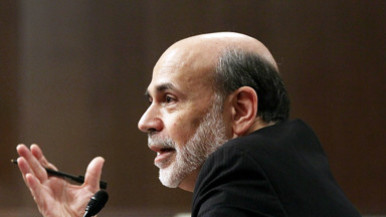
Bernanke Tells Congress to Spend More Money


A Republican-appointed Federal Reserve Chairman telling Congress to spend more money.
Ben BernankeWell, not exactly -- but Ben Bernanke on Thursday urged Congress to give him a hand boosting the sluggish economy, which would involve avoiding massive spending cuts and tax increases scheduled to take place at the start of 2013.
The damage this double dose of austerity could do to the economy would likely swamp any stimulus the Fed might be able to throw at it with monetary policy, he warned in response to questioning during testimony before the Joint Economic Committee Thursday morning. In fact, Congress should get on the stick and start doing its part to help the economy now with fiscal stimulus, he suggested.
"Monetary policy is not a panacea. It would be much better to have a broad-based policy effort addressing a whole variety of issues," he said. "I would be much more comfortable if in fact Congress would take some of this burden from us and address those issues."
Bernanke's comments came as financial markets waited breathlessly to see if he would promise a third round of quantitative easing, or bond purchases, to boost the economy. The U.S. stock market enjoyed its biggest rally of the year on Wednesday partly on hopes that Bernanke would promise QE3 after a series of disappointing employment reports and amid Europe's ongoing debt crisis.
Bernanke disappointed them. He promised no new stimulus, and instead pressed Congress to deal with the so-called "fiscal cliff" of spending cuts and tax increases, looming just months away.
"All of these measures together, if they all occur, will amount to a withdrawal of spending and an increase of taxation, depending on how you count, between 3 and 5 percent of GDP," he warned, "which would have a very significant impact on the near-term recovery, whatever benefits you might see in those programs in the very long term."
He declined to suggest which combination of spending increases and tax cuts lawmakers might want to undertake, but he warned them that they had just months to act before the economy fell off the fiscal cliff. Congress imposed the automatic austerity measures on the country last year as punishment for Congress's own failure to come up with a long-term plan to cut deficits. They have about six months to act, or the entire country will pay for Congress's sins.

"What is particularly striking here is that this is all preprogrammed," Bernanke told the frequently vacationing Congress. "If you all go on vacation it's still going to happen."

Tuesday, February 28, 2012

Dow Closes above 13,000

A board on the floor of the New York Stock Exchange shows the closing number for the Dow Jones Industrial average, Tuesday, Feb. 28, 2012. The Dow Jones industrial average closed above 13,000 Tuesday, the first time since May 2008, four months before the financial crisis. (AP Photo/Richard Drew)Still, Greenhaus said, while 13,000 is just a round number, "it's a round number that's likely to make many Americans feel better about the economy and the stock market. It's another sign that things are getting better."

Traders work on the floor of the New York Stock Exchange Monday, Feb. 27, 2012. (AP Photo/Richard Drew)
The Dow Jones industrial average rode a surge of confidence in the economy Tuesday to close above 13,000, a threshold it last crossed four months before the financial crisis of 2008 and the darkest days of the Great Recession.
The milestone extended a strong rally in stocks since the start of the year, and it came after a fitful week in which the Dow repeatedly floated above 13,000 only to fall back by the end of the trading day.
The Dow closed at 13,005.12, a close enough call that the gain of a single stock, Johnson & Johnson, made the difference. The Dow last closed above 13,000 in May 2008, four months before the fall of the Lehman Brothers investment bank and the worst of the crisis.
"I think it's a momentous day for investor confidence," said Jack Ablin, chief investment officer at Harris Private Bank. "What this number implies is that the financial crisis that we were all losing sleep over, it never happened, because now we're back."
Dow 13,000 comes at a time when Americans are feeling better about the economy than they have in a year. The Conference Board, a private research group, said its consumer confidencejumped to 70.8 in February, up from 61.5 in January.
The report came out at 10 a.m. and lifted the Dow above 13,000. It stayed there most of the day.
"Two months ago, we were talking about a double-dip recession. Now consumer confidence is growing," said Ryan Detrick, senior technical strategist for Schaffer's Investment Research.
He said the Dow's milestone "wakes up a lot of investors who have missed a lot of this rally."
The average first pierced 13,000 last Tuesday but fell back by the close. It floated above the milestone again on Friday and Monday, but slipped below both days. A strong rally for stocks this year seemed stalled as worry built on Wall Street about climbing prices for oil and gasoline.
Tuesday's gain puts the Dow 1,160 points below its all-time high, set Oct. 9, 2007. The Great Recession began two months later.
The milestone could draw some fence-sitting investors back into the market and add to the gains, said Brian Gendreau, market strategist at Cetera Financial Group.
"Already here in the first two months, we've blown past the consensus expectations for the entire year, and that certainly gets people's attention," he said.
The Dow started with its best January since 1997 and has added to that gain. The index is up 6.5 percent for the young year.
Other averages have fared even better: The Standard & Poor's 500 is up 9 percent, the Russell 2000 index of smaller stocks is up 11 percent, and the Nasdaq composite index, dominated by technology stocks, is up 14 percent.
The other major indexes sit at multi-year highs as well. The S&P closed Tuesday at its highest level since June 2008, and the Nasdaq has not traded so high since December 2000, during the bursting of the bubble in technology stocks.
Just last August, the Dow dropped 2,000 points in three frightening weeks. Investors were worried about the European debt crisis, gridlock in Washington over the federal borrowing limit, a downgrade of the U.S. credit rating and the threat of another recession.
After Labor Day, the recession fears melted away. Since then, the stock market has been engaged in a tug-of-war between optimism over the improving American economy and fear that crisis in Europe would derail the U.S. recovery.
The optimists have been winning.
The Dow cruised to 13,000 the old-fashioned way, riding the economy higher. The unemployment rate has come down five months in a row, the first time that has happened since 1994.
The economy added 243,000 jobs in January, one of the three best months since 2006. Gains were surprisingly robust in industries across the economy, including the strongest hiring in manufacturing in a year.
In the stock market, the improving economy has translated to slow, steady gains — about 20 points a day for the Dow, averaged over the eight weeks. The index has gained more than 100 points on only three days, and it has not fallen 100 points on any day.
On Tuesday, seven of the 10 industry groups within the S&P 500 index were higher, with information technology and consumer discretionary stocks leading the way. Utility stocks, traditionally solid investments in a weak economy, were lower.
Microsoft led the 30 stocks in the Dow with a gain of 1.7 percent for the day. Johnson & Johnson had the biggest price change. It gained 73 cents and was responsible for 5.52 points of the Dow's gain, enough to clear the 13,000 level.
The S&P 500 gained 4.59 points for the day and closed at 1,372.18. Technical traders said it was a breakthrough because the S&P has been hemmed between 1,100 and 1,370 for months.
The Nasdaq gained 20.60 and closed at 2,986.76.
Prices for U.S. Treasurys were little changed. Besides the consumer confidence figure, investors wrestled with a Commerce Department report that businesses cut back on machinery and equipment in January.
The price of the 10-year Treasury note dropped 12.5 cents for every $100 invested. The yield edged up to 1.94 percent from 1.93 percent late Monday. Shorter-dated Treasurys were nearly all unchanged.
The euro rose against the dollar a day before the European Central Bank is expected to give banks in the region another round of loans. A jump in U.S. consumer confidence also pushed traders to buy the euro.
The Dow first cracked 13,000 on April 25, 2007, when the unemployment rate was 4.5 percent, far below today's 8.3 percent, and the economy was growing at a relatively healthy clip.
From there, it was a quick ride to the Dow's all-time high. The average crossed 14,000 in July 2007, then peaked at 14,164.53 on Oct. 9, 2007. Concerns about weak corporate earnings and tighter credit were already haunting the market, though.
The trip back down to 13,000 was less pleasant. It took little more than a month. Ten months later came the fall of Lehman Brothers and the financial meltdown. The Dow hit bottom on March 9, 2009, at 6,547.05.
Analysts say the stock market has grown accustomed to lingering threats this year, including a debt crisis in Europe and an economic recovery in the United States that is still not as strong as economists would like.
The price of gasoline has emerged as the latest worry. A gallon of regular costs $3.72 on average. The price has risen 21 days in a row. Economists worry whether gas will climb high enough to cut into consumer spending in the rest of the economy.
"It's important to remember that the stock market is not the U.S. economy, and the U.S. economy is not the stock market," said Dan Greenhaus, chief global strategist for the brokerage BTIG. "Most people are likely to say, 'Dow 13,000. So, where's my job?"
The consumer confidence reading of 70.8, while much stronger than the 63 that economists were expecting, is still far below the level of 90 that indicates a healthy economy. It was above 110 in mid-2007, before the recession.

Watch MSNBC’s Dylan Ratigan has a meltdown over the meltdown

Visit msnbc.com for breaking news, world news, and news about the economy